From 10 MW to 5 MW: how we got a project in Amsterdam permitted despite grid congestion
October 2026 · 3 min read
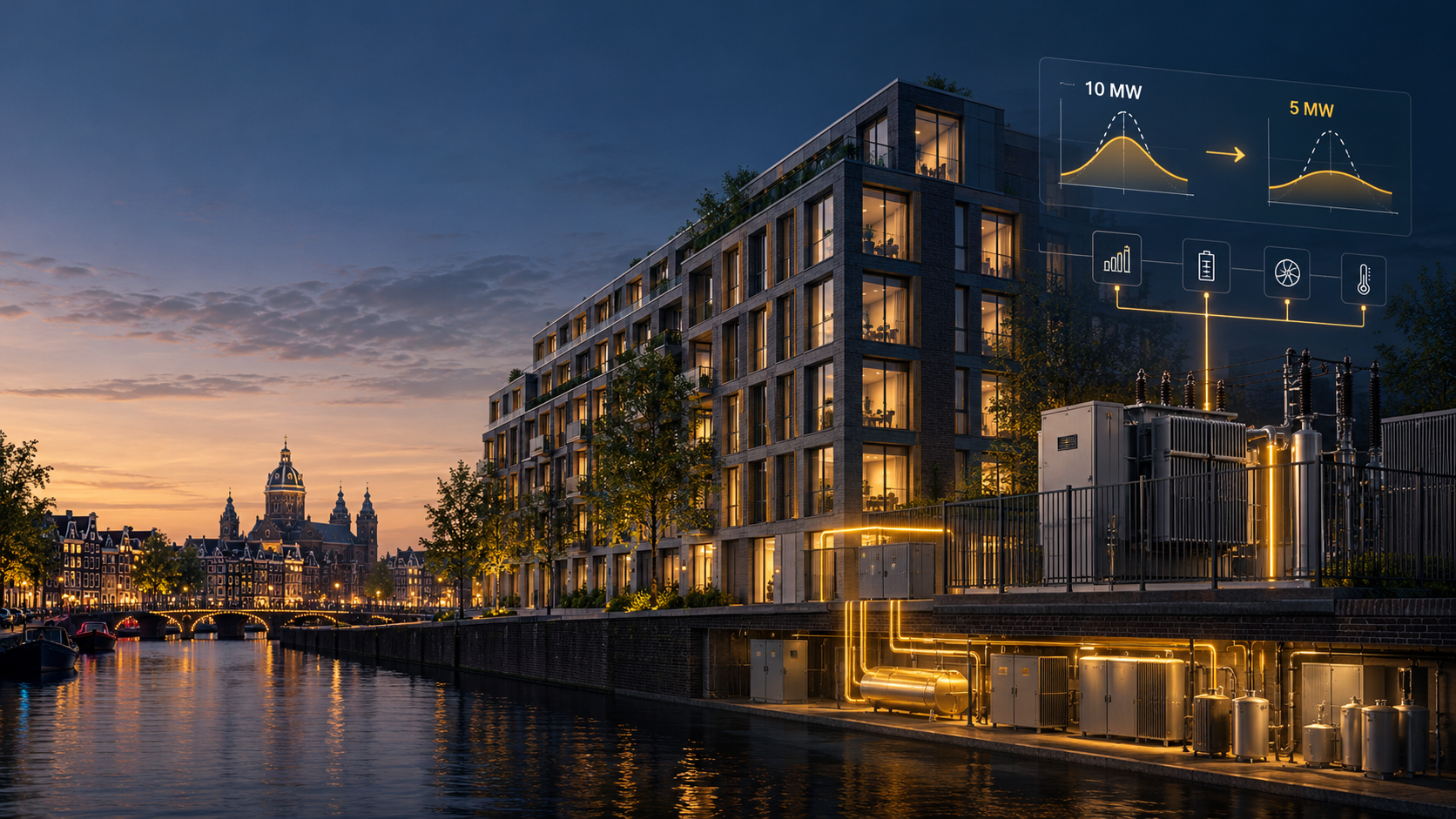

The short version: a student-housing project in Amsterdam could not get its building permit. The design needed 10 MW of grid capacity, but the grid could only offer 5 MW. APARA redesigned the electrical side, with peak-shaving and load management, and showed with an electrical system study that the building could run safely on 5 MW. Working with a fellow resident of the Energy Transition Campus Amsterdam (ETCA), who handled the thermal side, we got the permit granted.
The problem: a project that only worked on paper
Grid congestion is now one of the biggest risks for new developments in Amsterdam and across the Netherlands. In many areas the network operator cannot offer new or bigger connections for years.
In this project the gap was simple and hard: 10 MW required, 5 MW available. Without enough capacity there was no permit, and without a permit there was no project. The usual options are to wait for a grid upgrade, which can take years, or to shrink the project. Neither worked for the developer.
Our approach: start from the real load, not the nameplate
Connection requests are often sized by adding up the rated power of every piece of installed equipment. Real buildings never draw all of that at the same moment. Our job was to find the real peak and then manage it.
1. Electrical system study
We modelled the building's load profile: which consumers run, when they run and at what power. This showed how far the real peak sits below the theoretical 10 MW, and which loads can be shifted or limited without the occupants noticing.
2. Peak-shaving and load management
We designed a control strategy that keeps total demand under the agreed connection limit. Flexible loads such as heating systems, EV charging and ventilation are scheduled and capped, so the building never goes over 5 MW, even at its busiest moment.
3. Working with the thermal side
A large part of a residential building's electrical demand is really heat. We worked with a fellow ETCA resident who designed the thermal system. Our part was the electrical integration: making sure the thermal installation and its control logic fit within the electrical limit.
4. Evidence for the permit authorities
We wrote it all up in technical documentation showing that the building could be served reliably on 5 MW. The authorities accepted it, and the building permit was granted.
What this means for other projects
Grid congestion is often treated as a flat "no". In our experience it is often a design question:
- Connection requests are often oversized. A proper load study often shows the real peak is well below the requested capacity.
- Flexibility is worth capacity. Smart load management can replace megawatts you would otherwise have to wait years for.
- Integration matters. Electrical, thermal and control systems have to be designed together, not one after the other.
- The study comes first. Clear technical evidence is what convinces network operators and permit authorities.
Why it worked: ETCA as a working ecosystem
APARA has been a resident at the Energy Transition Campus Amsterdam since 2022. This project shows what the campus is for: specialists in the same building tackling one problem together, each in their own discipline. We brought the electrical engineering and systems integration, and our partner brought the thermal expertise. Our founder, Adrián Aparaschivei, presented this case at the ETCA Open Day in May 2026.
Stuck on a grid connection?
If you are a developer, building owner or industrial operator facing a capacity limit or a blocked permit, we can help. APARA carries out electrical system studies, load analysis and peak-shaving design, and delivers the electrical installation as an EPC contractor.
Related insight: The Cyberbeveiligingswet is in force: what it means for your electrical assets
Share
Related insights

October 2026
Black-powder filtration: PLC and SCADA HMI for a gas facility in the Netherlands
Black powder damages valves, meters and compressors in gas systems. For a gas facility in the Netherlands we delivered the complete control scope of a filtration skid: engineering, ATEX cabinet, PLC, HMI and commissioning.
Read more
October 2026
The Cyberbeveiligingswet is in force: what it means for your electrical assets
The Dutch Cyberbeveiligingswet has applied since 15 August 2026. For energy companies, substations and protection systems are now part of the cyber risk the board answers for. Here is what that means in practice, and how we handle it in our engineering packages.
Read more
July 2026
Europe's electrification target meets the grid: why bridging is engineering
Brussels targets 46% electrification by 2040 while Dutch grids run on temporary gensets. It is not a contradiction, it is a transition. The constraint is transport capacity, and bridging it is engineering work: grid integration, protection, SCADA and EMS.
Read more